THE FADED SPOTLIGHT

by Michael Lawrence

List of "A" Movies


Anaconda (1997) Poster
ANACONDA (1997) D+
dir. Luis Llosa

There are bad movies, and then there’s Anaconda—a film that wears incompetence like the Crown Jewels. It’s not only bad. It’s gloriously, stubbornly, almost offensively bad. I’ve certainly enjoyed my share of monster movies of dubious quality in my movie-watching time. And this one has the right so-bad-it’s-good pedigree. But apart from Jon Voight’s supremely silly bout of overacting, I never actually enjoy this. For a movie about a giant snake swallowing people whole, it’s surprisingly tedious.

The plot is basic. It’s about a documentary crew boating down the wide and windy Amazon River hoping to get footage of a lost, perhaps mythical tribe. But what they stumble across instead is a giant, man-eating anaconda. Such is life, for a documentary film crew. Suddenly, they’re not so much filmmakers as an all-you-can-eat buffet for a customer of one—and it plans on clearing the spread. Among the crew is Paraguayan snake hunter Paul Serone (Voight, speaking with an accent of indistinguishable origin), whose reliability as a guide falls somewhere between “untrustworthy” and “actively plotting your demise.”

The rest of the cast exists. Ice Cube glares sourly as though someone slipped lemon juice in his canteen. Owen Wilson sticks around long enough to say “Wow” (metaphorically, if not literally) before becoming snake food. Jonathan Hyde gamely brings class, but he might as well be hanging lace curtains in a burning building for all his efforts. Jennifer Lopez looks like she wandered onto the wrong set. And Eric Stoltz is unconscious, as though doing his best impression of a Madame Tussauds wax figurine of Eric Stoltz. Then there’s the snake—a CGI disasterpiece, roughly as intimidating as a Windows 95 screensaver. When it’s not looking rubbery and mechanical, it’s shiny and weightless.

The best thing I can say about Anaconda is that it runs a merciful 89 minutes, quick enough that you don’t have too much time to dwell on its failures. For all its comedy (intentional or not) and Voight’s scene-devouring lunacy, this is a movie that substitutes stupidity for charm and incompetence for camp. If you’re laughing, it’s probably only at yourself for being too stubborn to turn this thing off.
Starring: Jennifer Lopez, Ice Cube, Jon Voight, Eric Stoltz, Jonathan Hyde, Owen Wilson, Kari Wuhrer, Vincent Castellanos, Danny Trejo.
Rated PG-13. Sony Pictures Releasing. USA. 89 mins.
Analyze That (2002) Poster
ANALYZE THAT (2002) D
dir. Harold Ramis

Analyze That, the sequel to Analyze This, begins with Robert De Niro butchering the song “I Feel Pretty” from West Side Story. The final scene is Billy Crystal joining in for an equally off-key encore of that same tune. As bad as these musical renditions are, sad to say, they’re nothing compared to the movie in between.

The first film had a premise—grizzled mob boss Paul Vitti (De Niro) baring his soul to neurotic shrink Ben Sobel (Crystal)—that was flimsy at best. Here, that same premise is dragged out, wrung dry, and flopped onto the screen like a dying, gasping trout. This time, the FBI inexplicably decides that Paul’s bad singing means he must be mentally losing it and release him from prison and into Ben’s custody. He needs 24/7 psychiatric care, apparently.

What follows is a series of disconnected sketches that usually involve Paul trying (and failing) to hold down a string of legitimate jobs (car salesman, restaurant server, you name it). He finally lands a gig as a consultant on a gangster movie. Too bad he couldn’t have used his expertise to punch up the gangster movie he’s currently starring in.

De Niro, one of cinema’s most magnetic presences, does little more than wilt under this material. He phones in his performance with all the enthusiasm of someone stuck on hold with tech support. Crystal, usually a reliable comedic presence, is stranded with sitcom-grade dialogue and left floundering—trying to react to jokes that barely qualify as such. Lisa Kudrow is sidelined as Ben’s long-suffering wife, a role so thin that it might vanish if she turned sideways. The rest of the cast fills the runtime like set dressing in a bad high school play.

The film’s worst offense, though, is what little it does with its premise. A mobster consulting on a gangster movie should have some potential for good laughs: trying to size up the leading man, insisting stunt characters are holding pistols at the wrong angle. But the script settles for lazy, rote gags and tired clichés. The original was weak, but it at least qualified as a watchable diversion. This sequel, on the other hand, is so terrible that it borders on avant-garde.

Starring: Robert De Niro, Billy Crystal, Lisa Kudrow, Joe Viterelli, Cathy Moriarty, Reg Rogers, John Finn, Kyle Sabihy, Callie Thorne.
Rated R. Warner Bros. USA. 96 mins.
Analyze This (1999) Poster
ANALYZE THIS (1999) C
dir. Harold Ramis

Robert De Niro, the eternal mobster and patron saint of hard stares and sudden violence, finds himself not breaking kneecaps but breaking down—on a psychiatrist’s couch, no less. His name is Paul Vitti, a mafia boss stricken with panic attacks. His designated shrink is Ben Sobel (Billy Crystal), a man buttoned-up and completely flustered at where to even begin sorting out a man who usually sorts things out with a .38 Special. On paper, this setup should have been irresistible. Two archetypes colliding. Two worlds bashing heads.

But the movie doesn’t truly let those collisions happen. Conflicts feel cushioned. Softened into nothing more than sitcom safety. Even worse, the movie keeps circling the premise like it’s its own self-contained gag—“Ha! A mobster in therapy! Get it?” It becomes not so much a joke as it becomes a chant. OK, we get it. What else have you got?

But at least there’s one gag that hits hard enough to cut through the haze. Sobel hands Vitti a pillow to punch out his rage. But instead of lobbing left and right hooks into that stuffed sofa condiment, Vitti pulls out a gun and empties a few rounds into it. That’s the kind of joke this movie should have been packed with—quick, efficient, unexpected. Instead, all it does is highlight how lazy the rest of the movie feels.

The casting might be a dream, but they feel stranded. De Niro plays it hedged. Partly like a parody, partly serious, never committing to either mode. It’s as though he was too concerned the audience won’t get the joke if he goes too far either way. Crystal sputters and flails like a mediocre late-night host who finds himself forced to improvise without cue cards. Lisa Kudrow is marooned in the most disposable role comedy has to offer women: “the wife.” She’s mainly trotted out for interruptions and exasperated sighs.

Analyze This should’ve been a satire of masculinity, therapy, and mob mythology. But it ends up being neither dangerous enough to provoke thrills nor funny enough to produce consistent laughs. It’s all too timid, too slick—a one-line pitch for the studio executives that got stretched into two hours, reminding you again and again that there’s nothing else. Ultimately the kind of comedy that takes up brief space in your memory but gets filed away with the other mid-tier studio relics that you rented once on VHS, watched, and promptly forgot.

Starring: Robert De Niro, Billy Crystal, Lisa Kudrow, Chazz Palminteri, Joe Viterelli, Bill Macy, Leo Rossi, Kyle Sabihy, Rebecca Schull, Molly Shannon.
Rated R. Warner Bros. USA/Australia. 103 mins.
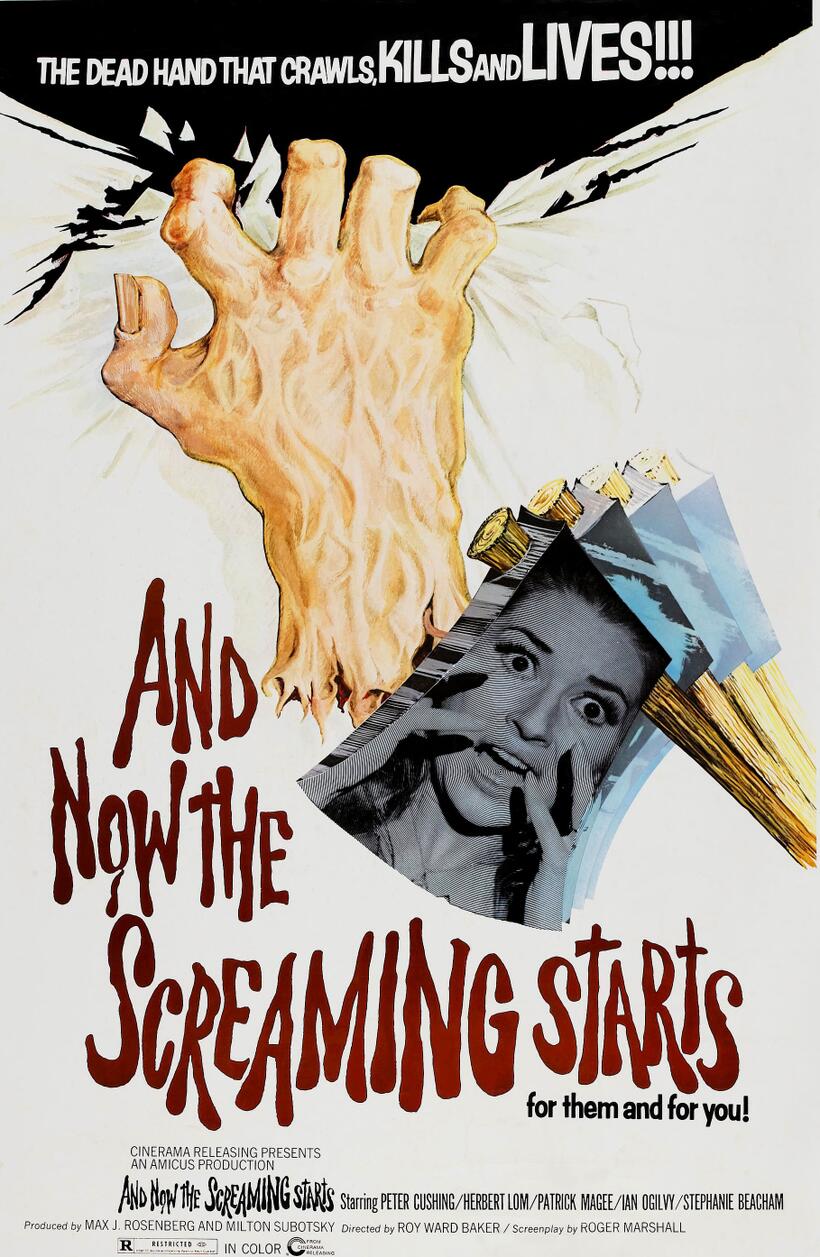
And Now the Screaming Starts! (1973) Poster
AND NOW THE SCREAMING STARTS! (1973) C–
dir. Roy Ward Baker

The title makes a promise that the movie itself barely remembers. Set in the late 18th Century, there are high collars, low morals, and a healthy level of B-movie misbehavior. But instead of giving us the kind of gothic filth you might hope for from Amicus (the British studio often tagged as second-tier Hammer), we get something that limps. More fussy than feral. More fog than fear.

The story follows Catherine (Stephanie Beacham), a newlywed who arrives at her husband Charles’ (Ian Ogilvy) countryside estate where she is immediately greeted by visions. Namely, a mutilated corpse that leers at her. It’s missing one hand but on the other, there’s a large grotesque birthmark—not a discoloration of the skin but a bloodstain seared into the flesh. It’s the first flare of a curse that brands, mutilates, and humiliates.

Catherine has married into a family whose sins are still collecting interest, and the retribution comes in the form of a spectral rape. Even this scene, though, is filmed with the queasiness of a Sunday matinee, as if the film is too timid to exploit the very horror it sets up despite its R rating.

The visuals are textbook Amicus: crumbling manors, haunted paintings, hands that skitter across the floorboards. There’s a certain dated appeal to the artifice—the cardboard tombstones, the prosthetic gore, the ghouls that look like wax figures accidentally left out in the sun—but appeal can’t fill in for imagination. What should feel lurid ends up oddly polite, like a séance hosted by someone’s nervous aunt.

Peter Cushing eventually drifts in, playing a psychiatrist with a medical degree in exposition. He’s good, of course—Cushing always is—but he’s mostly there to parse the plot. Herbert Lom, seen in flashbacks as the cursed patriarch Sir Henry, has the only real menace in the film. And even he feels stuck inside something far too neat to unnerve.

There are a few scattered moments that flirt with delirium. Portraits that leer, ghostly faces at the window, a disembodied hand that’ll strangle you senseless. But they arrive like stray pages from a better pulp novel, and they vanish just as fast. The title might scream, but unfortunately, the movie itself merely mutters.

Starring: Stephanie Beacham, Ian Ogilvy, Peter Cushing, Herbert Lom, Patrick Magee, Rosalie Crutchley, Guy Rolfe, Geoffrey Whitehead.
Rated R. Amicus Productions. UK. 91 mins.
The Angel Levine (1970) Poster
THE ANGEL LEVINE (1970) B
dir. Jan Kadar

A strange, creaky, and quietly affecting morality tale that plays like a theological fable that wandered into a kitchen sink drama and decided to stay. Zero Mostel stars as Morris Mishkin, a down-and-out tailor in New York—jobless, penniless, and tending to a dying wife (Ida Kamińska). Then things get weird.

He reports a Black man (Harry Belafonte) for stealing a fur coat who then flees and promptly gets struck and killed by a car. Hours later, that same man is waiting for Morris in his kitchen—alive and unbothered, claiming to be a Jewish angel named Alexander Levine. Belafonte plays him with a lot of nerve and almost no celestial refinement. In other words, this isn’t the Cary Grant model of divine intervention.

Levine swears and he sulks. He seems to be aware of what he was sent back to Earth to do but only has vague ideas of why. His task: convince Morris that angels exist. If he succeeds, he’ll earn his wings and presumably vanish to Heaven, never to be heard from again. Or at least until he gets a higher profile assignment. But this of course is a hard sell to Morris. He still thinks, as anyone might, this man came to enact some kind of revenge—and it had come in the form of this bizarre practical joke.

It’s an interesting premise, and it unfolds and moves as though it originated as a stage play, even if it wasn’t. The film consists of long patches of philosophical argument, metaphysical back-and-forth and spiritual irritation—the kind that would work well in a local theater. That’s not necessarily a complaint, but it gives this film a certain stiffness—like it’s pausing now and then for a curtain that never arrives. And the messages, while occasionally hitting, come off a bit scattered. There are themes here, about faith, doubt, race, divine bureaucracy—that don’t necessarily fit well together.

But the performances do help pull it all together. Mostel is pitch-perfect as a man whose belief system has eroded to dust. Belafonte plays the celestial visitor like someone who might’ve taken a wrong turn en route to heaven. The film never fully settles, but it’s sincere, distinctive, and worth watching—if only to see what happens when belief is asked to knock on the door of someone who’s already stopped answering.

Starring: Zero Mostel, Harry Belafonte, Ida Kamińska, Milo O’Shea, Gloria Foster, Eli Wallach.
Rated PG. United Artists. USA. 106 mins.
Animal Crackers (1930) Poster
ANIMAL CRACKERS (1930) B+
dir. Victor Heerman

The picture and sound quality of Animal Crackers mark a leap forward from their creaky previous picture, The Cocoanuts. But the two films are about equally funny—which is to say, it’s intermittently brilliant, but occasionally bogged down with a supporting cast that feels like the casting director pilfered them from a high school production of Drawing Room Farce.

The film revolves around an elegant soirée hosted by socialite Mrs. Rittenhouse (Margaret Dumont). She may or may not know what she got herself into by allowing the Marx Brothers through her front door, but she endures the madness with her usual air of impervious decorum.

Captain Spaulding (Groucho Marx) arrives freshly back from Africa, armed with a fresh stock of insults. Meanwhile, an overeager artist (Hal Thompson) hatches a harebrained scheme to swap a famous painting with his own forgery—not to steal it, but to dazzle the puffed-up art crowd into recognizing his brilliance. Unfortunately for him, though, he enlists Chico and Harpo—our favorite architects of comedic bedlam—to pull off the switch. Which means, naturally, everything must go spectacularly wrong before they somehow stumble into going right.

The Marx Brothers were never about storylines, of course, and Animal Crackers barely pretends to care about theirs. Although it’s not necessarily a poor one. It’s mostly scaffolding to string together scenes of escalating absurdity. The more pristine the setting, the more satisfying it is to watch them dismantle it. Groucho tossing off one-liners not only like he’s aware he’s the smartest person in the room but he wants to punish everyone else for it. One of his most famous zingers is immortalized here: “One morning I shot an elephant in my pajamas. How he got in my pajamas, I don’t know.” Groucho in a nutshell, logic bent until it breaks.

Meanwhile, Chico and Harpo spin in their own skewed gravitational field. Harpo is a silent whirlwind of anarchy who communicates through honks, winks, and exaggerated eyebrow gestures. Chico, with his fractured Italian accent and boundless confidence, at one point takes a piano solo and turns it into a Möbius strip. He forgets a verse of a song he’d been playing and endlessly circles back to the last part he remembers.

This film is shameless, gloriously unpredictable, and as messy as a tornado in a teacup. But that mess is the point. Structure and coherence are for lesser comedies. The Marx Brothers weren’t here to build—they were here to demolish, and Animal Crackers proves they could do it with precision and style.

Starring: Groucho Marx, Chico Marx, Harpo Marx, Zeppo Marx, Margaret Dumont, Lillian Roth, Louis Sorin, Hal Thompson, Robert Greig.
Not Rated. Paramount Pictures. USA. 98 mins.
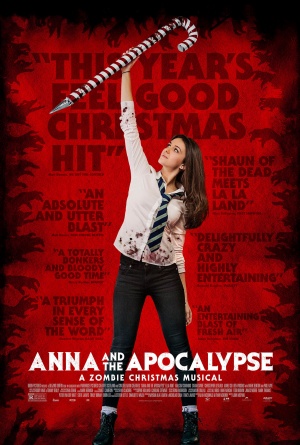
Anna and the Apocalypse (2017) Poster
ANNA AND THE APOCALYPSE (2017) B-
dir. John McPhail

It’s not every day that you come across a Christmas zombie musical comedy. And Anna and the Apocalypse is good for taking that premise and sprinting with it. At least at the start. The film kicks off with a devil-may-care attitude and a sly parody of zombie films. But then after jokes about gushing veins and head-rolling decapitations starts to run thin, the glee is abruptly smothered as the movie starts to play its zombie horror tropes straight.

That said, the film’s opening is undeniably delightful. There you’ll find Anna (Ella Hunt) cheerfully belting out the sprightly song “Turning My Life Around,” while being blissfully unaware that there’s an entire zombie apocalypse unfolding right behind her. A chipper showtime while the undead impaled on fence posts and windows are smeared with arterial spray.

But my favorite part of the film is a quick gag in a bowling alley—a moment that probably made me laugh out loud for 45 seconds straight. Where a zombie meets its grisly end at the end of a lane and its head rolls serenely back to them through the ball return.

But then the giddy mashup of genre clichés and musical theater bravado inexplicably decides to start taking itself seriously. The bright, zippy energy grinds to a halt, replaced by characters who are actually mourning their dead and spending time philosophizing about the apocalypse. The problem isn’t really that Anna and the Apocalypse is reaching for emotional depth. It’s that it’s tying itself in knots trying to reinvent itself. As if just being a movie about jokes wasn’t going to be enough. But that’d be roughly the equivalent of Blazing Saddles suddenly handing the reins to John Wayne halfway through filming, who promptly declared, “Enough of this foolishness,” and then turned it into a straight-faced Western.

And yet, despite this fundamental stumble, it’s hard not to root for this scrappy, bloodstained oddity. The songs—pop-rock confections dripping with theater-kid enthusiasm—are catchy, and the film itself, while messy and lopsided, is irresistibly weird. If the premise intrigues you even slightly, it’s worth a watch. Hardly a consistent experience, but it dances and sings—blood-spattered and unbothered.

Starring: Ella Hunt, Malcolm Cumming, Sara Swire, Christopher Leveaux, Ben Wiggins, Marli Sia, Mark Benton, Paul Kaye.
Rated R. Metro-Goldwyn-Mayer. UK. 98 mins.
Annabelle (2014) Poster
ANNABELLE (2014) C
dir. John R. Leonetti

You can tell a franchise is getting confident when it starts giving origin stories to its props. In The Conjuring, Annabelle pops up for a quick look in the Warrens’ room of cursed belongings. Now the prequel grabs that little moment and runs with it, turning it into the whole show. Supposedly based on a true story—though in real life Annabelle was just a Raggedy Ann doll. This one’s a porcelain, quasi-Victorian nightmare. (Not even demons can find a work-around for the intellectual copyright of Raggedy Ann, I guess.)

The film drops us into 1967 with Mia and John (Annabelle Wallis and Ward Horton), expecting their first child and trying to wrangle a suburban starter life into something that feels stable. The apartment is already crowded with vintage dolls. Glass eyes, stiff dresses. Exactly the kind of collection you don’t want to have when you’re stuck in a horror film. He turns up with the exact doll she’s been chasing for months and gives it a home on the shelf, looking quietly satisfied about it. But even on day one, the doll looks out of place. Every other piece in Mia’s collection feels harmless. This one feels like it came with its own memories. Mia and John don’t know it yet, this particular doll has a reputation. And bad objects tend to attract worse company.

One night, Mia hears a commotion next door. She doesn’t know it, but her neighbors were killed by two members of a demonic cult. And the violence is about to spill over to her house. But the cult members don’t get far. Police intervene. One attacker is shot. The other turns the knife on herself while gripping the doll, which is now dripping with her blood. Some kind of force was drawing them to the doll.

That nightmarish break-in might be over, but their nightmare’s just begun. They discard the doll and change houses, but somehow she shows up in one of their moving boxes. And their new place starts to go off-kilter. Sounds in empty rooms. Things nudged out of place when no one was there. A stove erupts when it shouldn’t. A sewing machine snaps at her finger. Little incidents that feel staged rather than unlucky. Now and then, Mia swears she isn’t alone—a woman lingering at the edge of the room, vanishing the moment she turns. The doll never shifts, yet it dominates the space anyway, eyes locked on some distant point.

Leonetti, to his credit, knows how to load a room with threat. He keeps the framing cramped. But the people inside these rooms never feel as vivid as the spaces around them. Mia and John sell the scares, but everything else about their characters feels faint. Alfre Woodard shows up as Evelyn, the neighbor who spots Mia’s fear a little faster than anyone else. She helps Mia find out more about these cult members. But these relatively warmer, more human, interactions just slips away as it resets itself for the next scare.

The Conjuring worked because it let the dread thicken instead of rushing the scares. Annabelle, by contrast, goes in for short bursts. Fast jabs of sound or movement that don’t amount to much after they’re over. The doll itself has presence, no denying that, but the movie doesn’t really turn that presence into a compelling story with real shape.

As a franchise curio, it’s fine. Polished. Watchable. It does the creeping and recoiling you expect. But Annabelle probably worked best when she was only a glimpse—just a nasty little object tucked away in the Warrens’ spook room.

Starring: Annabelle Wallis, Ward Horton, Alfre Woodard, Tony Amendola, Kerry O'Malley, Brian Howe, Eric Laden, Ivar Brogger, Gabriel Bateman.
Rated R. Warner Bros. Pictures. USA. 99 mins.
Annabelle: Creation (2017) Poster
ANNABELLE: CREATION (2017) B–
dir. David F. Sandberg

If you figured the first Annabelle gave you the whole backstory, think again. Annabelle: Creation kicks back to the 1940s. To a quiet, depressed farmhouse where doll maker Samuel Mullins (Anthony LaPaglia) spends his time holed up in the workshop. He’s in the midst of putting together that familiar porcelain doll. The one that looks so menacing from the get-go that if an evil spirit didn’t eventually calling that husk home would feel like gross negligence on their part.

He and his wife Esther (Miranda Otto) have a daughter, Bee. Right up until they don’t. She’s killed in a roadside accident, which sends the Mullins spiraling into a grief so deep it drives them to reach for anything that might feel like a grip.

But it’s prayer specifically that they reach for. Prayers sent outward in hopes that something answers back. And, unbelievably, something does. Something that feels to them like the spirit of Bee herself. So they let that presence settle into her old doll, convinced they’ve just been handed back a piece of their daughter. But it turns out that they couldn’t be more wrong. While a spirit did indeed move into the doll, it wasn’t Bee. It was something malevolent. And once they realize it, they lock the doll away and throw away the key.

Twelve years pass. The farmhouse stays frozen in that grief. But the Mullins open their doors to a group of orphaned girls—as a way, as encouraged by their priest, of bringing some life back into their home. But looking back, they should have continued to stew in their grief. During hide-and-seek, one girl slips into a door that never should’ve budged and winds up face-to-face with that terrifying looking doll. And then suddenly, everything in that house that had been sleeping now isn’t.

To this film’s credit—and what primarily makes this a marked improvement over the previous entry—is it gives us a handful of characters who feel scrappy and likable. They’re not necessarily memorable, but they feel in the moment like actual kids—playful, anxious, brave in the ways children usually are. This makes the scares hit you more personally than they would have otherwise.

Where the film falters a bit is a matter of volume. It’s loud in ways The Conjuring never was. Halfway in, things get gimmicky. Bodies sliding across stairs. Rooms breaking into demon fireworks. And the doll—front and center—presiding over it all like some supernatural cheerleader for disaster. The movie knows how to throw a good shock or jump scare, but here it’s to the degree that it’s stuffing the silence with noise. The very space where real dread ought to live. And before long, the whole thing starts to feel closer to “haunted hayride” than something meant to worm under your skin.

As prequels go, Annabelle: Creation makes a real attempt at widening the doll’s mythology. It never gets anywhere near the pressure cooker of The Conjuring, but the aim is clear enough. A sturdy chapter in the mythology, even if it doesn’t leave much behind.

Starring: Stephanie Sigman, Talitha Bateman, Lulu Wilson, Anthony LaPaglia, Miranda Otto, Grace Fulton, Philippa Coulthard.
Rated R. Warner Bros. Pictures. USA. 110 mins.
Annie (1982) Poster
ANNIE (1982) B
dir. John Huston

Annie feels no obligation to shake off its musical stage roots. Watch it at home long enough and you might start believing there’s a Broadway marquee blinking somewhere outside your window. Director John Huston almost never wades into this kind of froth, but he goes whole hog into the theatrical lift. This is a movie propped up by big feelings and eager faces and a brand of sparkle-eyed cheer that seems determined to outlast infinity.

Aileen Quinn, the red-mopped title kid, slips right into that current. She’s freckled, stubborn—and that smile is broad and practiced, looking like it was wired for projecting past an audience. Maybe she didn’t have to go this cheeky, but what exactly are you expecting from a musical that turns childhood suffering and poverty into something you can tap out “It’s a Hard Knock Life” to?

The world around Annie plays along. Ms. Hannigan, the alcoholic orphanage caretaker (Carol Burnett), shuffles through her chores like she’s running on fumes and whatever she drank yesterday. Oliver Warbucks, the billionaire who reacts to warmth like it’s an unexpected tax audit (Albert Finney), barrels in barking orders. He gives Annie a quick once-over, and only then does something in him start to loosen. And Grace Farrell, his impeccably composed secretary (Ann Reinking), has that poised warmth you notice right away. She also gives off the faint sense that she’s the one actually keeping things upright.

Once Annie steps out of the orphanage, the movie slips straight into Depression-era fantasy. Warbucks—tasked to be her week-long guardian, a bit of image burnish cooked up by Grace—seems less interested in parenting than in shaking up his own schedule. But Finney sells the thaw, playing it like a man discovering unfamiliar muscles in his own face. He’s just perpetually a half-beat behind the sunnier version of Warbucks the script keeps pushing him toward. Later, a kidnapping pops up to jolt the story, but it mostly feels like the film clearing its throat before heading into the finale.

The songs are the surest thing in the movie. “Tomorrow,” “It’s a Hard Knock Life,” and “You’re Never Fully Dressed Without a Smile” move through the film like they already know they’re the main attraction. Which they are. “Let’s Go to the Movies” gives the film its biggest, least-apologetic burst of showmanship—a time capsule from that old fantasy engine that built the musical in the first place. Dozens of dancers make patterns blooming across the floor—wheeling, folding, opening like a living kaleidoscope while the camera floats above them.

The rest is bright, shallow, occasionally frantic—probably even irritating, depending on your mood—but not difficult to sit through as a whole. The Depression gets scrubbed down here—cleaner than anything you’ll find in an actual photograph—and whatever hardship remains is mostly just décor. But that’s the deal the movie strikes. Annie isn’t in the business of selling realism or depth. It’s selling the notion that with enough optimism, money, and a well-timed key change, the world might just start bending your way. As far as distractions go, call it durable. Maybe even a charm.

Starring: Aileen Quinn, Albert Finney, Carol Burnett, Ann Reinking, Tim Curry, Bernadette Peters, Geoffrey Holder, Edward Herrmann.
Rated PG. Columbia Pictures. USA. 127 mins.
Annie Hall (1977) Poster
ANNIE HALL (1977) A
dir. Woody Allen

People call Annie Hall a romantic comedy. But that really only scratches the surface of everything it’s up to. One moment it’s tossing off a joke. The next it’s knee-deep in neurosis. And then other times it veers into wandering asides—the kind people use to talk themselves through a day. The pieces don’t always line up at first. But eventually, you’ll notice, the fragments start fitting together into a shape. A sort of honest streak that you can actually follow.

Woody Allen stars as Alvy, a man who likes to trace through old moments of his life like he’s rummaging in a drawer. But every road he wanders down eventually brings him back to the subject of Annie Hall (Diane Keaton) and that tricky, weightless thing they once called a relationship.

For a stretch, Alvy and Annie click wonderfully. Then one day they realize they don’t. So Alvy goes back through his life, from the beginning. Starting all the way from childhood. Through the bright bits, the small hurts, the rest of the rubble. He spends this movie trying to decode how someone as full of life as Annie could have wandered away from him. Her dry smile. That nervous spark. The way she walks through a room. And always saying, “La de dah.”

Alvy narrates like he’s troubleshooting his own brain in real time. He jumps between first dates, flare-ups, digressions, memories, the occasional fantasy. Scenes often rethink themselves mid-stride—doubling back or detouring entirely. He’ll stop a flashback mid-flow to explain himself. Other characters within that memory will sometimes even answer back to him, like they’ve somehow tapped into the metaphysical broadcast. The film keeps bouncing between the small, exposed moments and the downright goofy ones, but none of it ever feels pasted on. This is simply how Alvy processes the world.

What stands out now is how gentle the film is beneath all the neurosis. Even how relatable it is despite the self-indulgence. Allen keeps deflating himself mid-thought, turning what might have been vanity into something more exposed.

If you only choose one Allen film, this is the one that makes the most sense. It stays quick, calm, and sure of itself, weaving humor and heartbreak together like threads pulled through the same stitch. Even the surreal moments feel like they spring organically out of the way the movie thinks. And the movie spilled into pop culture. It nabbed Best Picture and turned Diane Keaton into a whole aesthetic. It even handed modern rom-coms a roadmap that they keep using to this day. If this isn’t considered influential and an unqualified masterpiece, then who knows what is.

Starring: Woody Allen, Diane Keaton, Tony Roberts, Carol Kane, Paul Simon, Shelley Duvall, Janet Margolin, Colleen Dewhurst, Christopher Walken.
Rated PG. United Artists. USA. 93 mins.
Another Simple Favor (2025) Poster
ANOTHER SIMPLE FAVOR (2025) C+
dir. Paul Feig

A Simple Favor (2018) was a compact, twisty tangle of suburban noir, polished edges and attitude to spare. The sequel reaches for that same jolt, but the bite comes in softer this time. Still, fans of the first one might as well check this out. You have nothing to lose except your time.

Anna Kendrick is back as Stephanie—now a minor celebrity who’s developed a modest following after writing a book detailing the events of the last movie. Ever since, she’s been peddling lectures and autographs in bookstores full of true-crime tourists who like to lean in thinking she’s about to confess something that no other audience has been privy to. But then, during one of the readings, the audience gets their wish. Emily herself (Blake Lively) appears in the doorway, calm as a cloud. Which is unexpected, considering the last time anyone checked, she was not among the living.

Emily hands Stephanie an invitation. Her wedding. On the sunny Italian island of Capri. Transportation: private jet. Other guests: celebrities you might have heard of. Accommodations: luxurious. Stephanie pretends she could have said no at any point, but Emily’s the sort who drags you into her orbit whether you mean to go or not.

And Capri is dazzling. The sunny locale greets Stephanie with the kind of surface-level glamour and designer villas that overwhelm the eyes. But Stephanie can still sense something rotten in its center. The wedding itself already seems to be running hot on nerves. And that’s even before there’s a murder.

It happens to one of the groom’s business partners. He mysteriously turns up dead in his hotel room, and the local police seem suspiciously in a hurry to stamp it as an “accident.” But Stephanie isn’t fooled. Though she doesn’t even get a chance to put her finger on what happened when there is a second murder. The groom himself this time. Shot after slipping out of his own reception. And Stephanie is the only person who witnessed even a fraction of it. Which makes her the easiest suspect to grab.

The film has plenty to work with—two killings, old resentment, a witness no one wants to believe. But very little of it gets a chance to build. The atmosphere never tightens. It keeps coming apart, never holding onto a single idea long enough to do much with it.

While it reaches for the rhythm of the 2018 film, it gets nowhere close. Like it knows the tune but forgot how to play it. The film nonetheless makes a valiant effort to distract you with gloss. Capri looks almost too perfect—terraces, water, light hitting everything just right. And Blake Lively certainly knows how to wear an outfit that’s engineered for maximum impact. Even one particular hat she wears looks like it could cast shade on a small village.

Even if the current this time runs a little bit low, there’s enough here to please most fans of the original. The cast commits. The on-location shots are pure eye candy. There are more ludicrous plot twists. Stephanie and Emily fall back into their old dance, and there’s a certain pleasure in that. Another Simple Favor falls short, but it’s far from a disaster. It’s just a second glass of something that tasted better the first time.

Starring: Anna Kendrick, Blake Lively, Henry Golding, Andrew Rannells, Bashir Salahuddin, Joshua Satine, Kelly McCormack, Aparna Nancherla.
Rated R. Lionsgate. USA. 101 mins.
Antebellum (2020) Poster
ANTEBELLUM (2020) C-
dir. Gerard Bush, Christopher Renz

Antebellum storms in like prestige horror with a secret to drop and a big payoff designed to make the world gasp. But if there’s any kind of gasp in the room, it’s only because the movie whiffs the moment so badly. It’s a twist so lame that even M. Night Shyamalan should have wadded it up and tossed it in the bin. But at least the opening hook is compelling.

It drops us straight onto a 19th-century plantation. Confederate soldiers shouting and shoving people into place. Veronica (Janelle Monáe) is among them. She resists. A slave master answers such insolence with violence. And by the end of it all, she’s forced to respond to the name “Eve.”

Then the film takes a sudden turn. It’s present day, and Veronica wakes up in her chic house next to her husband. She is a well-known author who spends her days moving through interviews and panel discussions—airports and auditoriums—living the kind of schedule that looks controlled from the outside but draining from every other angle.

As Veronica moves through this present-day version of her life, the movie keeps dangling eerie carrots our way. Strange phone calls. Off moments. A lingering sense that someone is watching her a little too closely. You can feel the movie pitching itself as a seismic statement—race, history, identity in one big sweep. But it doesn’t come off any sharper than a parlor trick in dim lighting. Monáe at least stays sharp and focused. It’s just unfortunate that the script around her can’t manage the same kind of flair.

There’s one escape sequence late in the film that actually lights up. The big moment of flight, and I could feel my palms getting tighter. But that’s merely a moment. Not a rescue. In the end, this is a movie with noble enough intentions—a confrontational allegory in the style of Jordan Peele—but mostly all it does is strike a pose.

Starring: Janelle Monáe, Eric Lange, Jena Malone, Jack Huston, Kiersey Clemons, Gabourey Sidibe, Marque Richardson, Robert Armayo, Lily Cowles.
Rated R. Lionsgate. USA. 106 mins.
The Apartment (1960) Poster
THE APARTMENT (1960) A
dir. Billy Wilder

Some movies are so prim and neatly arranged you can practically see the pinstripes on the premise. The Apartment isn’t one of them. It starts with a sleazy little setup. An insurance worker, a schlub hungry to climb the corporate ladder, hands out his apartment key to the big brass of his company. They use the place to sneak off with women they don’t want to be seen with and do the things powerful men do when they think no one’s watching.

The schlub’s name is C.C. “Bud” Baxter, parked in a grid of desks like he’s waiting to be assigned a personality. Being invisible at his company eats at him. So when the executives start hinting about borrowing his apartment, he hears possibility instead of warning bells. It’s grubby work, but the need to matter has a way of rearranging your compass. A bad bargain—being kicked to the streets whenever one of his bosses has a certain itch—starts looking almost reasonable.

Miss Kubelik (Shirley MacLaine) is an elevator operator who has that loose, tossed-off warmth of hers—even when she seems one breath away from coming apart. She’s a woman in the office everyone likes but no one really sees. But Bud feels the pull of her personality almost immediately. She’s the first person in that whole building who feels real to him. Though maybe that’s part of that is how damaged she seems.

And it turns out it’s Bud’s boss, Mr. Sheldrake (Fred MacMurray, cool as a fridge door), who’s doing the damaging. When Bud comes home after his big boss borrows the key, he stops in his tracks. Miss Kubelik is on his bed. Out cold from a fistful of sleeping pills. A clean $100 bill next to her, Sheldrake’s idea of generosity. She told herself it was a holiday gesture, right up until the truth hit: he’s never leaving his wife. He’ll probably even trade Miss Kubelik in for a new model as soon as she starts feeling too familiar. And that cash she’s left holding isn’t sentiment or kindness. It’s hush money, plain and cold.

And she took the pills because the bottom drops out of her precarious existence—the hope, the wanting, that thin picture of a future with Sheldrake she kept trying to make real. The bottom also drops out from under Bud. Sheldrake was a man he admired and hoped to step into the shoes of one day. Yet, he still wants to cover for Sheldrake. Bud’s neighbors—including a doctor (Jack Kruschen)—believes Bud is the awful womanizer, breaking their hearts callously.

Jack Lemmon gives Bud this careful, almost tiptoed quality. He’s funny, hesitant, quietly torn open. MacLaine lets Miss Kubelik hold onto a tired scrap of hope you recognize instantly. She still expects people to be decent, though life keeps presenting her with evidence proving the opposite.

The script and direction are crisp and unsentimental. No syrup. No soft landings. An unusually frank film, especially for the time. This movie feels like a slow waking-up—Bud sensing the ground beneath him might not feel so bad and figures that’s where he ought to stay. Billy Wilder keeps the film lean and a little beat-up. This is workplace grime sitting right beside a low-grade heartache. Then there’s this moment where the room seems to widen. Enough space to picture these two, worn-out as they are, taking a small step in a better direction.

Starring: Jack Lemmon, Shirley MacLaine, Fred MacMurray, Ray Walston, Edie Adams.
Not Rated. United Artists. USA. 125 mins.